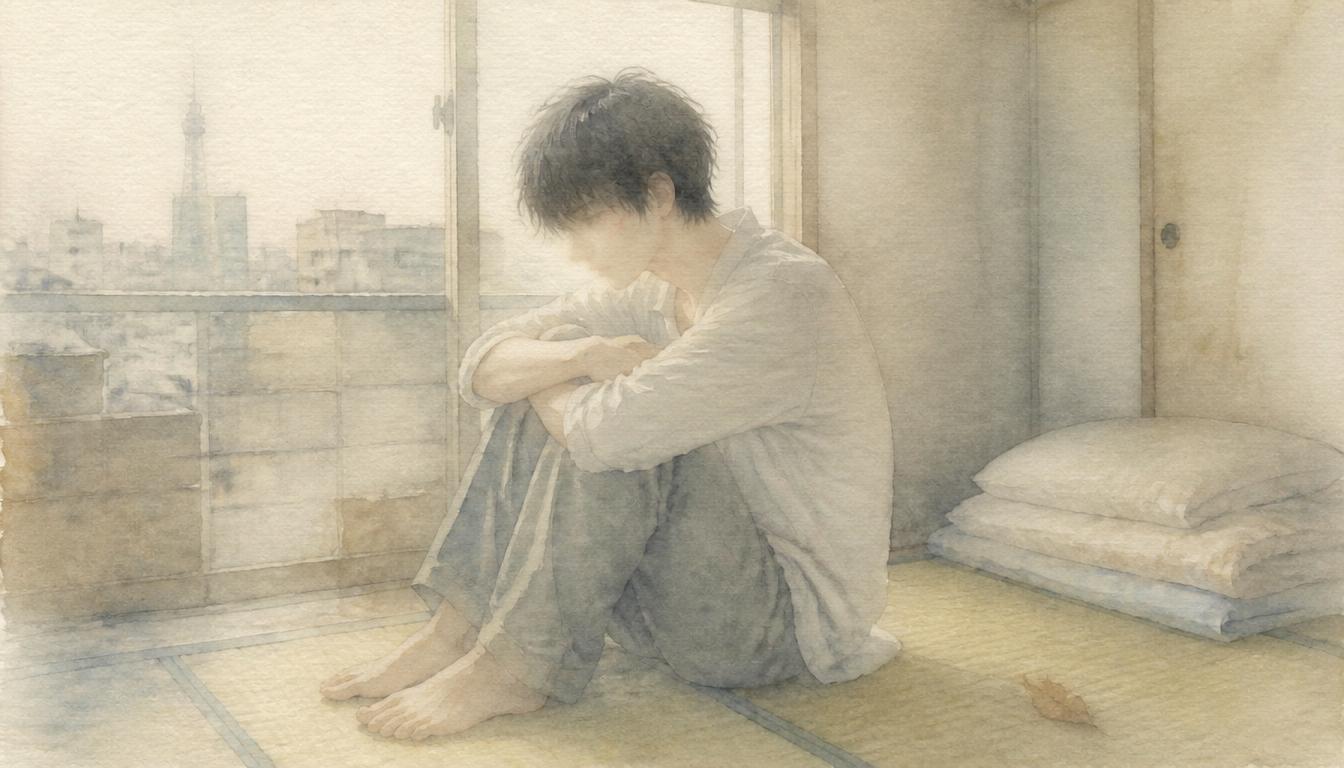
There I was, at that moment of existence and of life, alone in one of those so-called micro-apartments of Tokyo. The day had a greyish atmosphere, brought on by the frequent rain and mist. Paying an easy fifty thousand yen a month, the place was situated considerably far from the city centre. What my eyes beheld, and above all that city itself, formed a new stage in my life—a new life, if you will.
Two weeks had passed since my arrival in Japan, and I found myself far removed from my everyday routines and from the reality that had previously occupied my thoughts. There, on the worn and slightly stained floor of that room, I huddled in a long-sleeved white shirt and pyjama bottoms, while the futon—that slender, traditional Japanese mattress—lay resting in a corner. The futon then became a silent witness to my attempt to grasp this new life and how it fit into my endless search.
There had always been a spark within me, reminiscent of my early school days, like when the thrill of starting the second grade kept me awake all night. I had always harboured a hope in life, a promise of energy that occasionally peeked through my constant worries and exhausting obsessions. But now it was different; the space provided a fresh way of confronting the world.
More specifically, I felt the thrill of the unknown and the longing for a romantic life. I had always had a fondness for Japanese women—how can I put it? It is true that all women are beautiful, and Colombian women are certainly no exception; yet to me, Japanese women were the most beautiful in the world.
This world could feel as strange as those childhood blackouts when the lights went out and I felt utterly disoriented. Yet there I was, indeed, open to the vast universe of my dreams, passions, and ambitions. Japan, an archipelago in the Pacific rich with traditions and promises, unfolded before me as the ideal canvas to write a new chapter with whatever blank pages remained to me.
Life is hard after all. The part of me that yearns to sleep but cannot, and the part that forces itself to stay awake, bleed into one another. Just like when I felt the compelling urge to be myself, to align myself, to be blameless, to please the divine.
Sleep, that fleeting architect of ephemeral realities, turned yesterday into a shadow.
Sleep, which as days go by brings another reality, erasing what was, leaving crimson stains, dampening emotions, fracturing hearts. Today I woke up and tomorrow I will not be; yesterday I woke up and it ceased to exist.
Being—that colossal, unfathomable contemplation... yet so close. That which "is", literature and its realms, everything that surrounds me. For some reason, the world keeps my feet planted upon it, demands my attention, invades my thoughts; it compels me to consider it, speak of it, perceive it. Words that swarm inside my mind like an assembly, a gathering place, a forum to debate ideas, smooth out rough edges, and spill forth knowledge that is incomplete, flawed, and hasty.
I am part of being. Does it matter to me? What if I could detach myself? To be like that traveller walking a thousand years through a vast, boundless, peaceful forest... Truly, what obligation is there to think?
Soon my reflection is interrupted by the sight of a dried leaf. Its delicate veins captivate me and lend me the strength to stand up. There is a compact bathroom where every single element occupies space solely to maximise utility. It is barely more than a single square metre! The bathtub is attached to the shower. Above the sink, halfway over the tub, hangs a small and modest mirror with a shelf for toiletries. I wash my face. My reflection appears. I feel hungry. It was my reflection.
"Was"—a distant word, I position myself far from it; I gaze upon it with incorrigible, powerful, playful, defiant, triumphant eyes. Whatever has been, I can discard; no matter how much suffering I have endured, I do not bother bandaging myself. I want to move on to the next thought, to the next elucubration, to something that makes me want to live. I betray myself, or perhaps not—why is it mandatory to preserve one's mental health?
"Myself"—a repetitive, cyclical, conscious word, unlike that of an artificial intelligence that does not know itself, does not observe itself, does not suffer from itself. That is how it is; I, like an infant, must take care of myself, relive my wounds, stumble forward in the dark. Yes, I must still drink until I vomit, smear myself, and then clean myself up.
With what do I smear myself? With my vomit, with my unbalanced mental health, with the contemplation of the world.
I remember my cat. Beautiful, affectionate, feisty. He is gone now. He was with me in Colombia. Colombia is no longer here. Nor is the cat. I have no one to hold. I pull my knees up beneath my shirt. That way, the cold feels less piercing; the inside, not the outside—it is still summer. Here there are four seasons; in the Bogotá of my tropical homeland, the climate is always the same, the one that never bothers me. I pull my head inside my shirt as well, trying to flee, not to return.
I return to my childhood, to the tricycle, to mother's embrace, to mandarins, to cotton candy. To the misery of adulthood...
At last, exhaustion overtakes hunger. And I choose sleep over cooking. Food that soft hands once served me; food that appeared as though plucked from a fairy tale with happy endings.
Now I had to cook for myself. Only I could provide for myself. Here, far away, in this flat that never quite feels right. So I reach for the futon and wrap myself in it. It smells different; it is not like those hundreds of days when I tucked myself in and it felt the same every single time, clean or dirty, at home.